best dog toys for separation anxiety
Which Toys Really Help With Dog Separation Anxiety?
Last Updated: November 17, 2026
Quick Summary
The best dog toys for separation anxiety give your dog a job during alone hours but do not cure the condition. A puzzle toy for thinking, a durable chew for stress and a lick mat for settling cover most anxious dogs, alongside a behaviour plan for true separation distress.
- The Interactive Dog Treat Puzzle Toy (£19.99) is best overall because problem-solving holds attention longer than passive chewing.
- The 4 Zone Textured Dog Lick Mat (£12.99) is the best calming pick and suits almost every age and temperament.
- Give a long-lasting enrichment toy 15 minutes before you leave, not as you walk out.
- Keep three toys down at a time and swap one every two to three days to maintain interest.
- A dog with a history of swallowing foreign objects should have every chew toy supervised.
Table of Contents
- What Separation Anxiety Looks Like and How Toys Fit In
- Quick Comparison: Four Toys for Anxious Dogs
- Interactive Puzzle Toys for Dogs: Giving the Brain a Job
- Durable Chew Toys for Aggressive Chewers: Matching Chew Intensity
- Lick Mats, Stuffable Chews and the Calming Effect of Licking
- How to Keep a Dog Calm When Left Alone: A Departure Routine
- Toy Rotation, DIY Enrichment and Age-Appropriate Choices
- Building Your Enrichment Kit at Hound & Hollow
- Frequently Asked Questions
What Separation Anxiety Looks Like and How Toys Fit In
Separation anxiety in dogs is a panic response to being left alone, not a training gap or a sign your dog is being stubborn. It shows up as pacing, whining, excessive barking, destructive chewing and house soiling, usually within the first 30 minutes of your departure.
Here is the honest answer: the best dog toys for separation anxiety do not cure the condition. What they do is give your dog a job during the alone hours, which lowers boredom and channels natural instincts like chewing, sniffing and licking into something safe.
The distinction matters. A dog who shreds the sofa out of boredom needs enrichment. A dog who howls within minutes of the door closing may need veterinary advice and a behavioural modification plan. This guide covers both, and shows which toys suit each situation.
Quick Comparison: Four Toys for Anxious Dogs
Four toys cover most anxious dogs, and the right pick depends on how your dog copes when alone. Here is how our range lines up:
| Toy | Price | Best For | Key Feature |
|---|---|---|---|
| Interactive Dog Treat Puzzle Toy | £19.99 | Thinkers who need a challenge | Movable compartments with hidden treats |
| Interactive Dog Treat & Chew Toy | £11.99 | Dogs who chew and lick | Stuffable centre, textured rubber |
| 4 Zone Textured Dog Lick Mat | £12.99 | Fast eaters and lick-soothers | Four textures, suction cup base |
| Textured Dog Dental Chew Toy | £9.99 | Everyday chewers | Flexible rubber bristles |
Price
Best overall for most anxious dogs: the Interactive Dog Treat Puzzle Toy, because problem-solving holds attention longer than passive chewing. Best for calming: the lick mat. Best for chew intensity: the dental chew toy.
Interactive Puzzle Toys for Dogs: Giving the Brain a Job
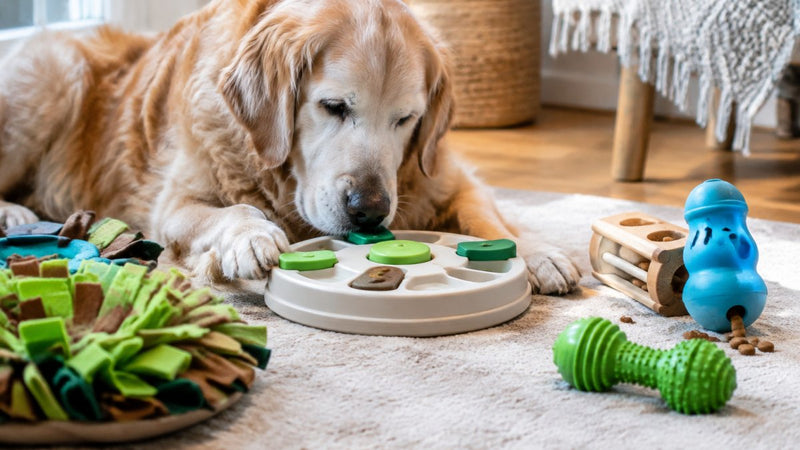
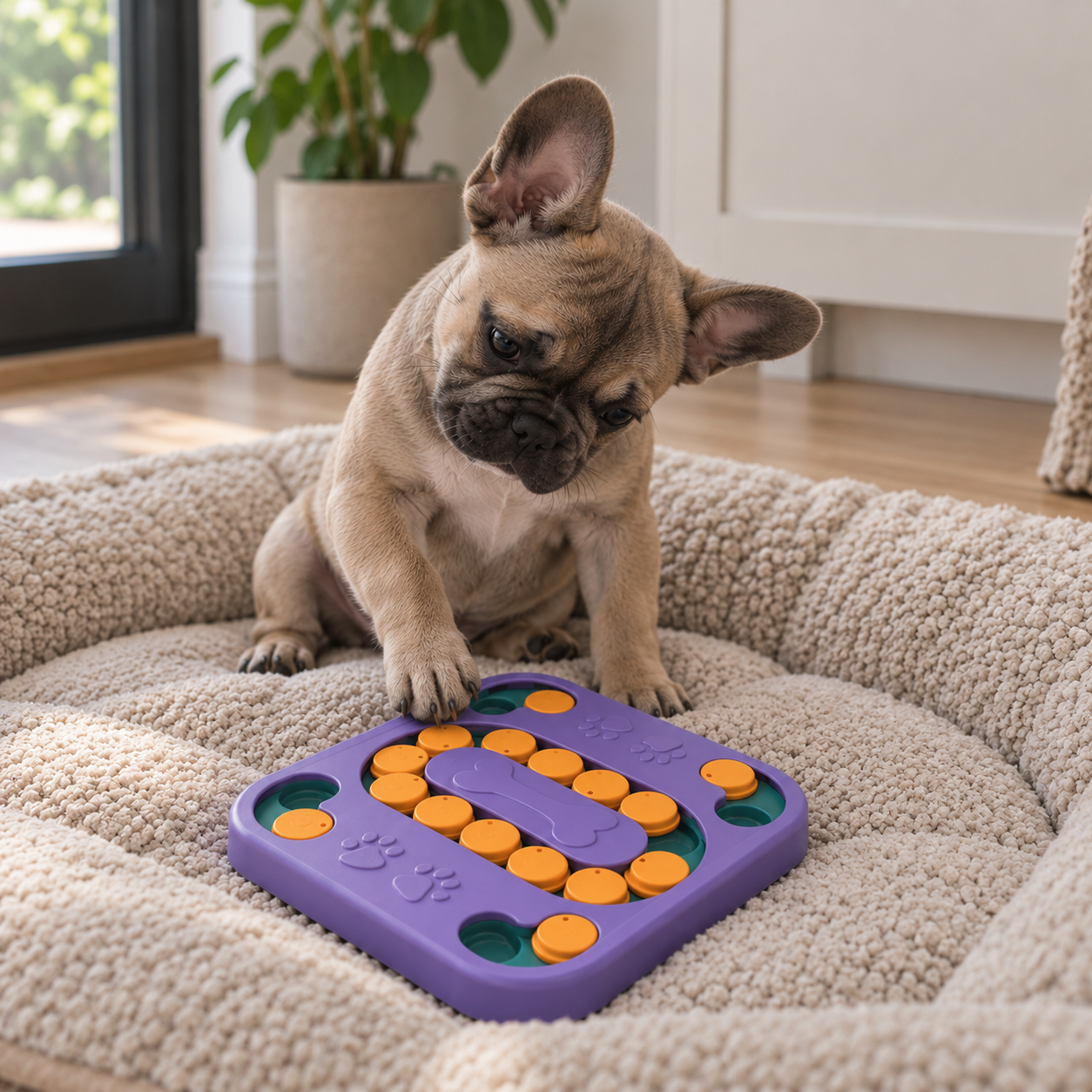
A puzzle toy works because it turns a treat into a task. Movable compartments hide food, and your dog has to nose, paw and problem-solve to get it out. That mental stimulation tires a dog in a way a walk sometimes cannot, and it gives the alone hours a focus.
The Interactive Dog Treat Puzzle Toy (£19.99) is built for exactly this, with movable compartments that encourage natural exploration and problem-solving. A puzzle your dog solves in ten seconds can become a boredom buster for about a week, then nothing. Start with treats wedged firmly into the compartments so the challenge lasts. Rotate the difficulty, and the toy stays interesting.
Watch out: for a heavy chewer, a puzzle is a supervised toy. Leave it down when you are home first to check your dog works the compartments rather than the plastic.
Durable Chew Toys for Aggressive Chewers: Matching Chew Intensity
Durable chew toys for aggressive chewers need to match the dog, not the label on the packet. A strong chewer destroys soft toys in minutes, and the wrong rubber can splinter or come apart.
Most guides stop there, and that is the gap worth closing. The real risk for a separation-anxious dog is not that a toy gets destroyed, it is what happens to the pieces while you are out.
Work through three checks before anything goes in the crate or the alone-room:
- The swallow test. If any part of the toy, a squeaker, a cap, a knotted end, a chunk of rubber, could pass through your dog's throat, it is not an alone-toy. Size up, not down. A toy that is slightly too large for your dog's mouth is safer than one that fits neatly between the jaws.
- The failure mode. Some materials fail by shredding into strips, which can wrap around the tongue or intestine; others fail by crumbling into chunks, which are a choking and blockage risk. Ask what this specific toy looks like after twenty minutes with a determined chewer, not after five minutes with a polite one.
- The escape route. Anything with a hole large enough for a jaw to get stuck, or a rope that can unravel into strands, is a supervised toy only.
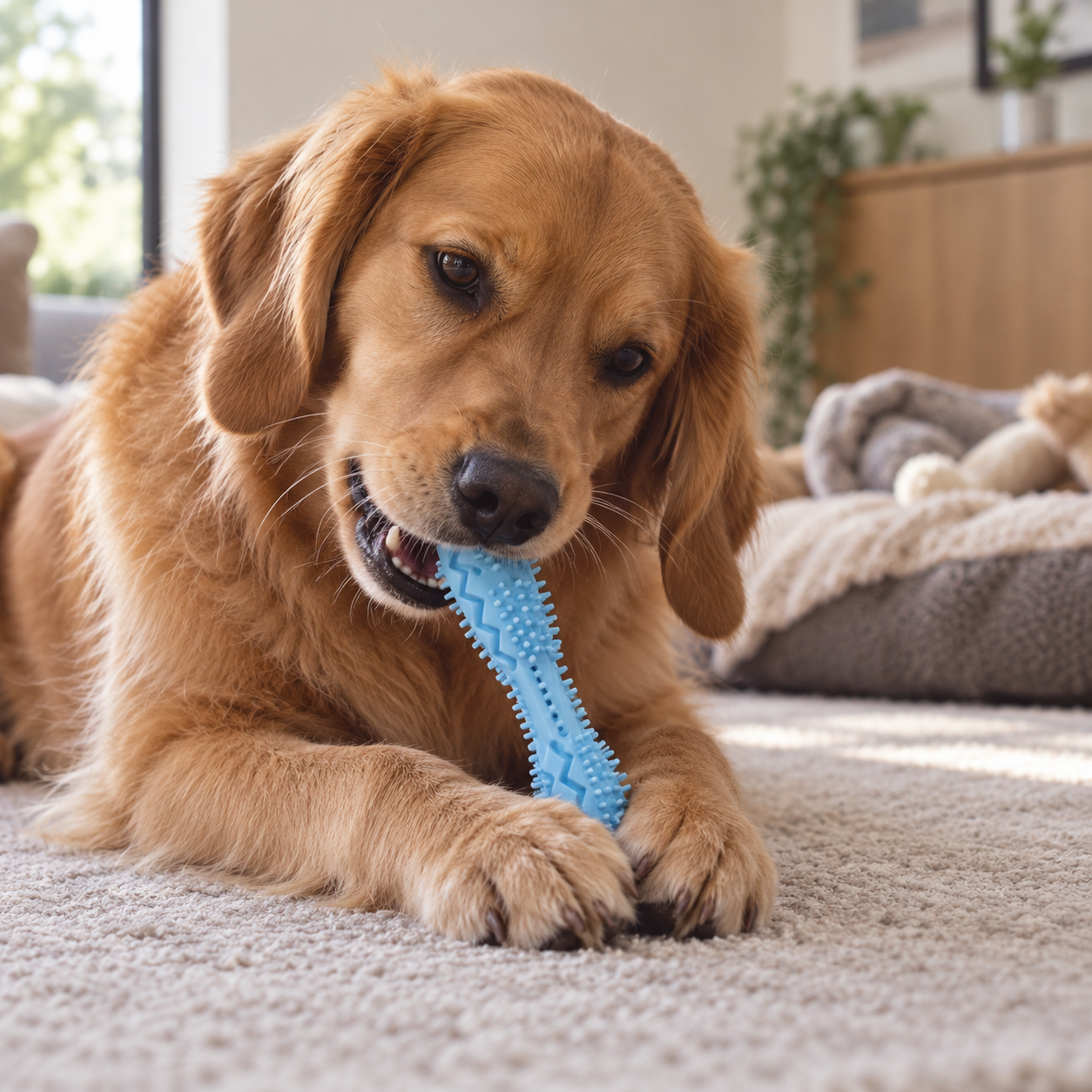
The Textured Dog Dental Chew Toy (£9.99) uses flexible rubber bristles and raised surfaces, which suits everyday chewing and gives a satisfying texture.
Watch out: if your dog has a history of swallowing foreign objects, or has had a blockage before, treat every chew toy as a supervised item and speak to your vet before leaving anything down.
Lick Mats, Stuffable Chews and the Calming Effect of Licking
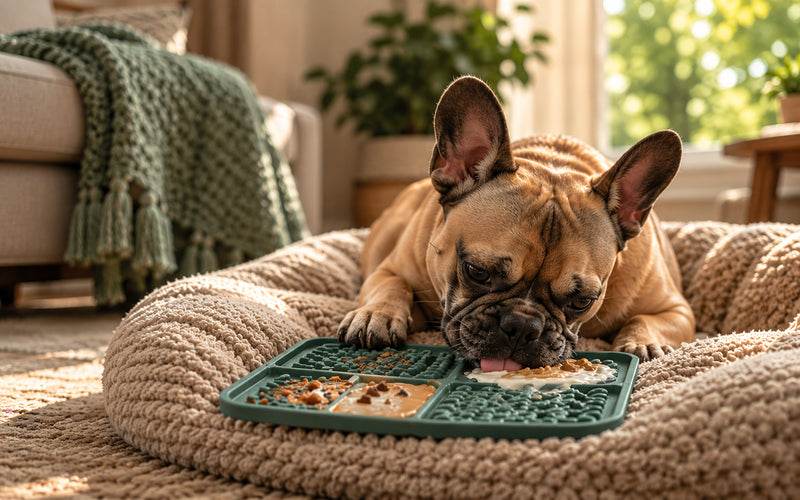
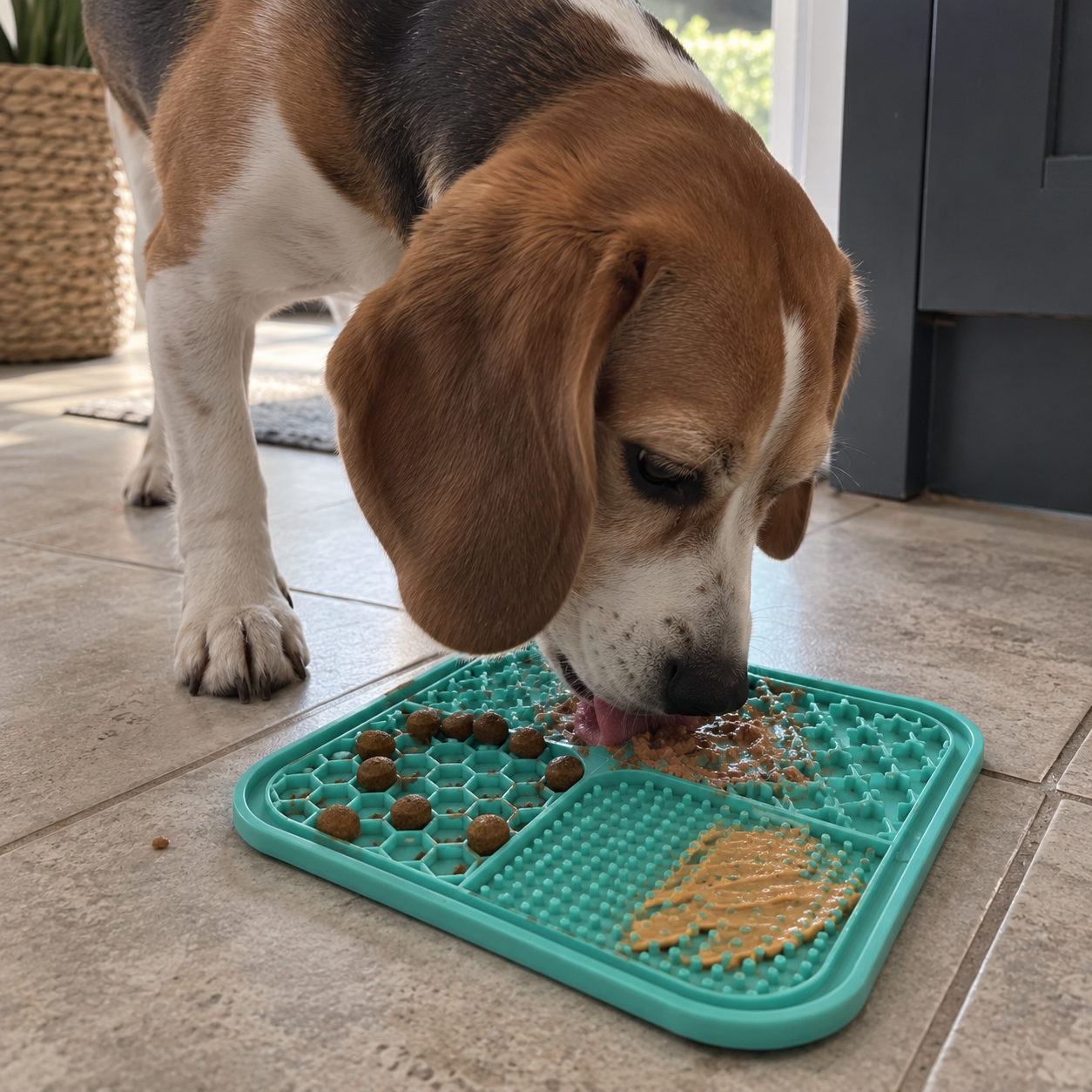
Licking can be a useful activity for some dogs, and it slows eating, which suits fast eaters and dogs who gulp. Spreading soft food across a textured mat can give a dog a focused activity for a period of time.
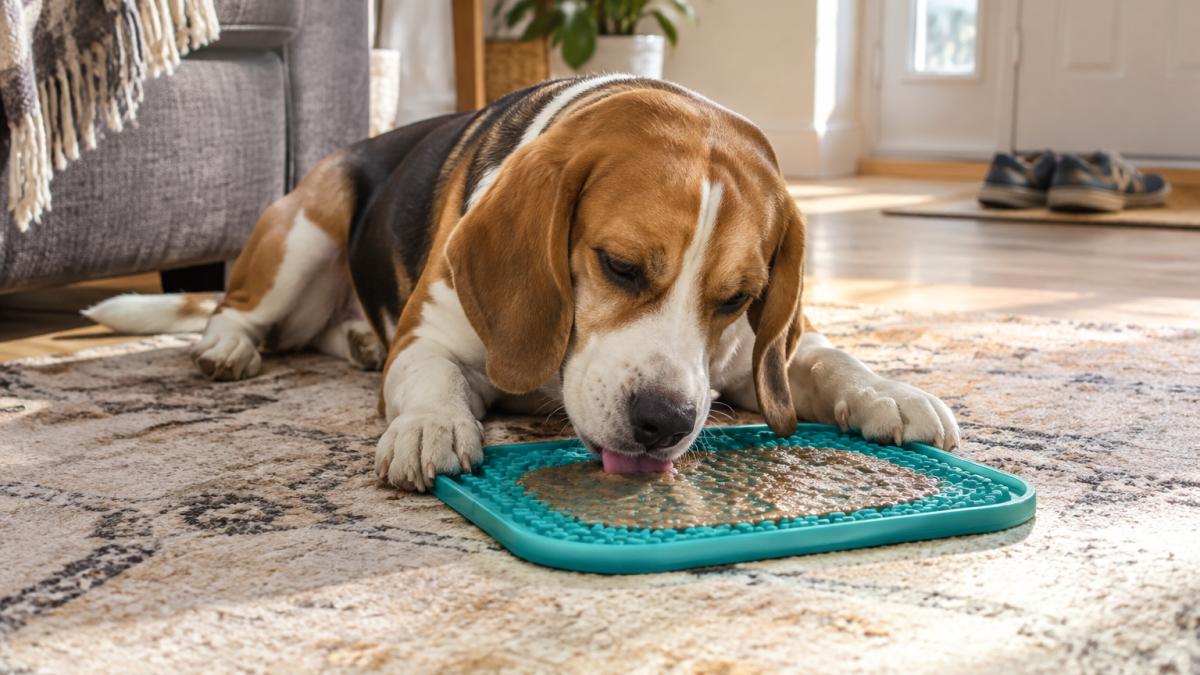
The 4 Zone Textured Dog Lick Mat (£12.99) features four different textures that encourage natural licking and slower feeding. The Interactive Dog Treat & Chew Toy (£11.99) has a stuffable centre and textured rubber surface for chewing, licking and treat discovery.
How to Keep a Dog Calm When Left Alone: A Departure Routine
How to keep a dog calm when left alone comes down to a predictable, low-drama exit. Anxious dogs read your cues, and jangling keys or a rushed goodbye can raise anxiety before you have left the drive. Build a routine that makes departure boring.
- Give a long-lasting enrichment toy 15 minutes before you leave, not as you walk out.
- Keep goodbyes flat and calm. No fuss, no long speeches.
- Leave a worn item of clothing with your scent near the dog's bed.
- Practise short absences first, building up over days.
- Keep departures at the same time and in the same order.
The aim is to break the link between your leaving and panic. If your dog shows severe separation distress, pacing, whining and destructive behaviour that does not ease, speak to your vet. A vet can rule out medical causes and advise on a behavioural modification plan.
Toy Rotation, DIY Enrichment and Age-Appropriate Choices
Toy rotation is the cheapest upgrade you can make, and it is the one thing most guides mention and almost none explain.
A workable rotation looks like this. Keep three toys down at any time, one thinking toy, one chewing toy, one licking toy, and store the rest out of sight.
DIY enrichment fills the gaps between toys, and it matters most for owners who cannot justify a cupboard of premium products. A few that cost nothing:
- The towel burrito. Roll kibble or treats into a bath towel, then knot it loosely. Your dog has to unpick the knots to get the food. Start loose for a nervous dog and tighten as confidence grows.
- The muffin-tin hunt. Drop a treat into each cup of a muffin tin and cover each with a tennis ball. Nosing the balls out is a low-cost puzzle that suits most sizes of dog.
- The frozen block. Freeze a stuffed toy or a lick mat overnight for a challenge that lasts far longer than the unfrozen version, which is useful on warm days and for dogs who finish a mat in two minutes.
- The cardboard shred. An empty cereal box with treats inside gives a destructive chewer a legitimate outlet. It is messy, so put it somewhere wipeable, and only offer it to dogs who shred rather than swallow cardboard.
Age changes the calculation more than most owners expect.
For more ideas, our journal has five simple enrichment ideas for dogs at home you can set up in minutes. If you are unsure which style suits your dog, start by finding the right play style for your dog.
Watch out: DIY enrichment is only as safe as its smallest component. Remove string, staples and plastic windows from cardboard before offering it, and never leave a towel-knot toy down with a dog who eats fabric.
Building Your Enrichment Kit at Hound & Hollow
An anxious dog does best with a small, rotating kit rather than a cupboard full of toys. We would build it around three jobs: a puzzle for thinking, a chew for stress, and a lick mat for settling. That trio covers the alone hours without overwhelming your dog or your living room.
Everything we stock is chosen to encourage natural instincts and curiosity, and our range is organised around play styles so you can match the toy to your dog. If you are shopping for a dog you do not know well, start with the lick mat: it suits almost every age and temperament, including seniors with sensitive teeth.
Your dog does not need a cure in a box. They need a routine, the right outlet for their instincts, and toys that hold up to real use.
Frequently Asked Questions
Do toys actually help with dog separation anxiety?
Toys do not cure separation anxiety, but they reduce the boredom and restlessness that make it worse. A stuffed chew or puzzle gives your dog something to do in the first ten minutes after you leave, which is often the hardest part. Pair toys with a calm departure routine and gradual time alone. If your dog paces, whines, or barks for long periods after you go, speak to your vet, as that pattern needs a behavioural plan rather than a new toy.
What are the best durable chew toys for anxious dogs?
Look for flexible rubber with textured surfaces rather than hard plastic or bone. A textured dental chew toy with rubber bristles, like the Textured Dog Dental Chew Toy at £9.99, gives a heavy chewer satisfying resistance without the risk of cracked teeth. Match the toy to chew intensity: soft rubber for gentle chewers, thicker textured rubber for dogs that destroy things in minutes. Always supervise the first few sessions and remove any toy that starts to break apart.
Are puzzle toys safe to leave with a dog alone?
Many are, provided you choose the right one and test it first. Start with the puzzle while you are in the room so you can see how your dog uses it. Avoid puzzles with small removable pieces for dogs who swallow things whole. A sturdy treat puzzle with movable compartments, like the Interactive Dog Treat Puzzle Toy at £19.99, is a good starting point. Rotate puzzles so your dog does not solve the same one in seconds every day.
How do I keep my dog occupied while I am at work?
Build a small rotation: a frozen stuffed chew for the first hour, a puzzle for mid-morning, and a lick mat for the afternoon. Freeze stuffed toys overnight so they last longer. Leave a long-lasting chew out and put the rest away, then swap them the next day so novelty does the work. Combine this with a consistent departure routine: a short walk, a calm goodbye, and no fuss when you return.
How do I introduce a new toy to an anxious dog?
Introduce it while you are home and your dog is relaxed, not as you head out the door. Show the toy, add a small amount of food or a favourite treat, and let your dog investigate at their own pace. For puzzle toys, start with treats easy to reach and let difficulty build over a few days. For lick mats, a thin layer of soft food is enough at first. Positive reinforcement works better than forcing interaction.