gentle enrichment toys
5 Gentle Enrichment Toys for Senior Dogs
Quick Summary
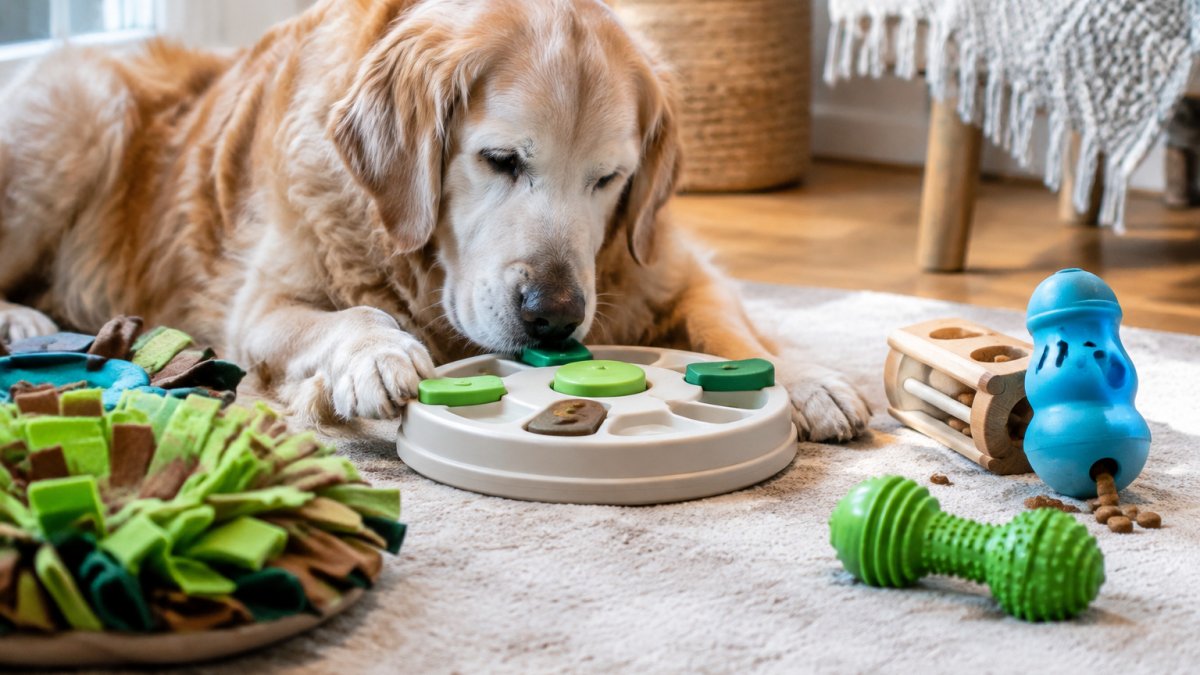
Gentle enrichment toys are low-effort activities such as lick mats, slow feeders and textured chew toys that give senior dogs something to sniff, lick or solve without strain. Match the toy to your dog's mobility, teeth and senses, and keep sessions to five to ten minutes.
- Score your dog on mobility, dexterity, food motivation and experience, then match the toy to the lowest score.
- Place toys on a low, stable, non-slip surface so arthritic dogs do not have to bend, reach or brace.
- Choose high-contrast toys for dogs with vision loss and keep the toy in the same spot each session.
- Start with the easiest version of a toy, such as one treat in an open compartment, then add steps gradually.
- Stop any session if your dog shows pain signals and speak to your vet if they appear repeatedly.
Table of Contents
- Why Senior Dogs Still Need Mental Enrichment
- How to Choose Gentle Toys by Ability, Teeth and Mobility
- Our 5 Gentle Enrichment Toys for Senior Dogs, Compared
- Introducing Enrichment Gradually and Stopping Before Your Dog Tires
- Low Impact Dog Enrichment Ideas Beyond the Toy Box
- Choosing Your Senior Dog's First Enrichment Toy Today
- Frequently Asked Questions
Why Senior Dogs Still Need Mental Enrichment
Last Updated: November 17, 2026
Older dogs still need their minds worked, and gentle enrichment toys are one of the simplest ways to do it.
Enrichment is any activity that gives a dog something to do with its brain and senses.
Many owners assume older dogs have outgrown play, but a quiet activity often suits them better.
Keep the session short. Five to ten minutes of gentle work is often enough, and you can stop as soon as your dog loses interest.
How to Choose Gentle Toys by Ability, Teeth and Mobility
The right toy depends on what your dog can comfortably manage today, not what it enjoyed as a puppy. Match the toy's size, contrast, scent, height and difficulty to your dog's current function.
Start with a structured effort guide
Before you buy anything, score your dog honestly on four axes; a simple low/medium/high rating for each narrows the choice quickly.
- Mobility: Can your dog stand and shift weight comfortably, or does it prefer to stay lying down? Low mobility points to flat lick mats and floor-level sniffing; medium opens up stationary puzzles; high can handle a toy that rolls or shifts.
- Dexterity: Can your dog paw, nudge and grip, or does it mainly lick and nose? Reduced dexterity suits textured mats and stuffable toys; full dexterity suits sliding-compartment puzzles.
- Food motivation: Highly food-motivated dogs can handle more steps; less motivated dogs need strong scent and an easy first win.
Match the toy to the lowest score across those four axes, not the highest. A dog with good mobility but poor dexterity still needs a low-dexterity toy.
Adapt for arthritis and stiff joints
Place toys on a low, stable, non-slip surface so your dog does not have to bend, reach or brace. A lick mat on a flat floor beats a toy that must be pushed around, and a rubber-backed rug reduces slipping. Avoid toys that roll away and force a chase; a dog with sore joints will often abandon them rather than risk a slip.
Adapt for vision loss
Contrast matters more than colour: choose toys that stand out against the floor, a dark mat on a pale floor, or a light toy on a dark rug. Keep the toy in the same place each session so your dog learns the location by memory, and guide its nose to the toy rather than waving it in the air.
Adapt for hearing loss
A dog that cannot hear you will not respond to a spoken cue or a squeaker. Use scent and touch instead, keeping a consistent routine so the session's start is predictable. Never startle a deaf dog by touching it from behind while it is focused on a toy.
Adapt for cognitive decline
For dogs showing confusion, pacing or house-soiling, keep activities very simple and familiar: the same toy, in the same spot, at the same time of day, with a single step counting as a complete session. Familiar smells are more reassuring than novel challenges. If your dog seems distressed rather than engaged, stop and speak to your vet; sudden behaviour changes can have medical causes.
Match the material to the mouth and the maintenance
Watch out: a toy that is too hard, too small or too worn is a choking and tooth-fracture risk, so supervise every session and retire anything cracked, chewed through or shedding pieces.
Watch your dog's body language. Relaxed, steady licking or sniffing is a good sign. Pacing, whining or turning away means the task is too hard or the session has run long.
Our 5 Gentle Enrichment Toys for Senior Dogs, Compared
We have chosen five options from our range that suit older dogs well, each working in a different way so you can match your dog's ability and your routine.
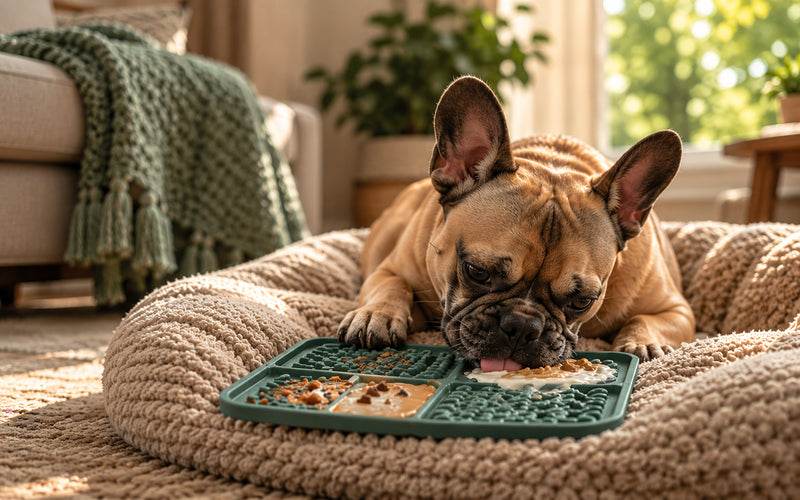
- 4 Zone Textured Dog Lick Mat: a flat, low-effort option with four textures for slow, rewarding licking.
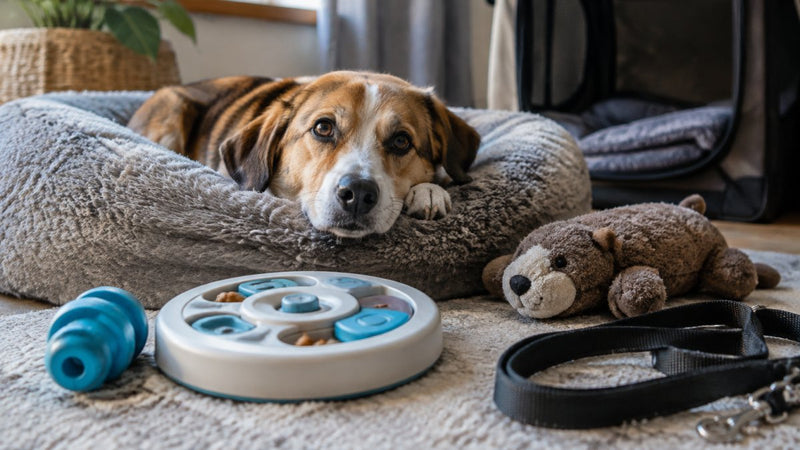
- Interactive Dog Treat Puzzle Toy: a gentle problem-solving toy with movable compartments and hidden treats.
- Rotating Dog Puzzle Slow Feeder: a meal-time puzzle with layered compartments that slows eating.
Comparison Table: Features, Pros, Cons and Prices
| Toy | Price (GBP) | Main Use | Best For | Key Feature |
|---|---|---|---|---|
| 4 Zone Textured Dog Lick Mat | £12.99 | Licking | Low-mobility dogs | Four textures |
| Interactive Dog Treat Puzzle Toy | £19.99 | Treat puzzle | Curious, clever dogs | Movable compartments |
| Rotating Dog Puzzle Slow Feeder | £34.99 | Slow feeding | Dogs who eat too fast | Layered compartments |
| Interactive Dog Treat & Chew Toy | £11.99 | Chewing and stuffing | Gentle chewers | Stuffable centre |
| Textured Dog Dental Chew Toy | £9.99 | Gentle chewing | Everyday chewing | Flexible textured rubber |
Price (GBP)
Pros and Cons of Each Option
4 Zone Textured Dog Lick Mat (£12.99)
- Pros: Simple to use and easy to place on a flat floor.
- Cons: Needs spreading food or a soft treat, and the mat should be wiped clean after each session.
Interactive Dog Treat Puzzle Toy (£19.99)
- Pros: Gives a clear problem to solve, rewards gentle thinking, and suits a dog that enjoys sniffing out treats.
- Cons: Can frustrate a dog if the challenge is too complex.
Rotating Dog Puzzle Slow Feeder (£34.99)
- Pros: Turns mealtime into enrichment and slows eating.
- Cons: The highest price in this list.
Interactive Dog Treat & Chew Toy (£11.99)
- Pros: Stuffable, so you can adjust the difficulty, and suitable for quiet chewing.
- Cons: Check the textured surface regularly for wear, and remove any loose pieces.
Textured Dog Dental Chew Toy (£9.99)
- Pros: Affordable, with a textured surface that encourages natural chewing.
- Cons: It is not a substitute for dental care, and it should be checked for wear before each use.
Introducing Enrichment Gradually and Stopping Before Your Dog Tires
Start with the easiest version of any toy: a small amount of food on a lick mat, or one treat in an open compartment. Once your dog finishes confidently, gradually add more food or another step.
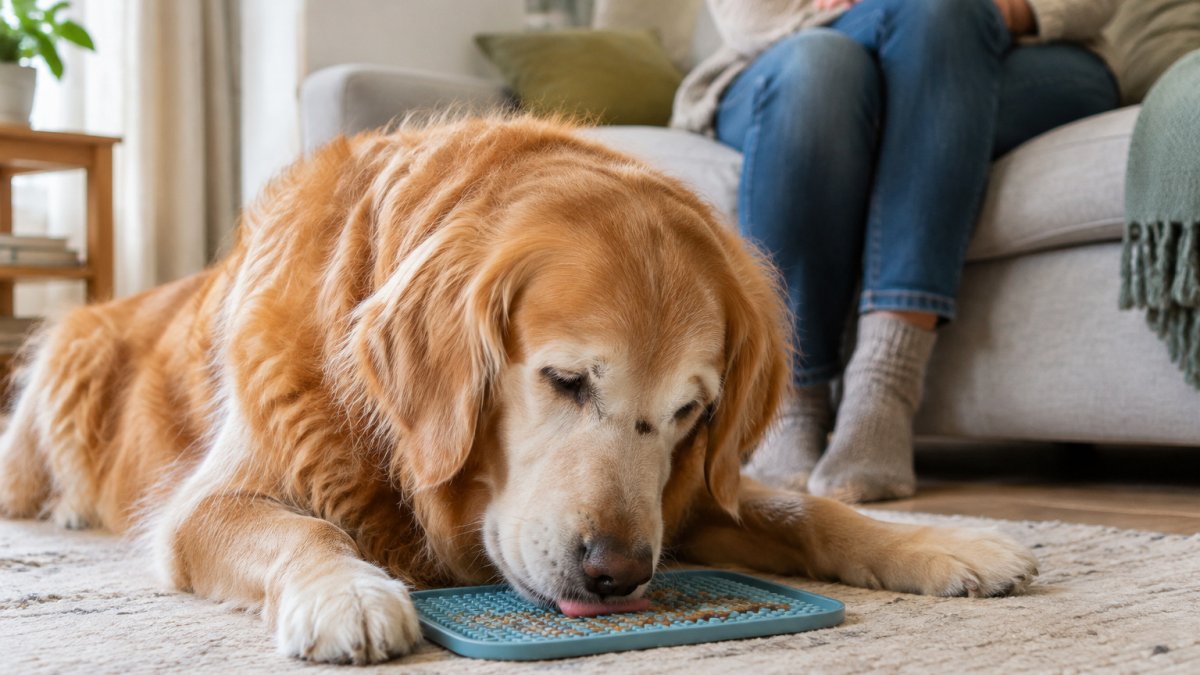
Keep sessions short at first, around five minutes, and watch for signs your dog has had enough: yawning, walking away, lying down and ignoring the toy, or stressed repetitive licking. Stop before your dog gets tired or frustrated.
Supervise every session, especially with chew-based toys, and remove any loose pieces. If your dog gets food stuck or shows mouth discomfort, stop and speak to your vet.
Low Impact Dog Enrichment Ideas Beyond the Toy Box
You do not need a shelf of toys to enrich an older dog's day, and for dogs on restricted diets, weight-management plans or with allergies, non-food enrichment is often the better route. These ideas work alongside the toys above and adapt for vision loss, hearing loss and cognitive decline.
Non-food enrichment for restricted diets
If your dog cannot have extra treats, swap food for scent, texture and attention. Scent work is often the most satisfying non-food option because it uses the nose rather than the mouth.
- Scent games with safe scents: Hide a cotton pad dabbed with a dog-safe scent, a little of your dog's own kibble crushed, or a pet-safe herbal scent, under a cup or in a corner, and let your dog find it. Reward with praise or a portion of the daily ration rather than an extra treat.
- Texture and licking without calories: Spread a thin layer of your dog's normal wet food, or a dog-safe paste approved by your vet, on a lick mat. If your dog is on a prescription diet, check with your vet before adding anything.
- Cardboard and paper shredding: A plain cardboard box or a sheet of unprinted paper gives a dog something to nose, paw and shred. Supervise closely and remove staples, tape and ink-heavy packaging.
Scent and contrast adaptations for sensory loss
For a dog with vision loss, scent becomes the map: keep scent games in a small, familiar area, place the scent source in the same spot each time, and guide your dog's nose to it rather than calling. For a dog with hearing loss, use a tap on the floor or a hand signal to start, and keep the routine identical.
Gentle sniffing walks and scatter feeding
Let your dog lead on a slow walk and stop to investigate smells, one of the easiest ways to keep an older dog mentally busy. Scatter feeding works too: toss a few kibbles onto a rug or flat grass and let your dog search, keeping the area small so there is no slipping or stretching.
Comfort, calming and low-impact activities
Licking and sniffing are calming because they are repetitive and give a dog control over a small task it can finish. To read more about why enrichment matters for your dog, see our dedicated article on its benefits.
Watch out: stop any session if your dog shows pain signals, reluctance to move, stiffness, yawning, lip-licking, turning away or a sudden change in breathing, and speak to your vet if these appear repeatedly, as they can indicate pain or illness rather than simple fatigue.
Choosing Your Senior Dog's First Enrichment Toy Today
Start with one toy that matches your dog's teeth, mobility and energy. The 4 Zone Textured Dog Lick Mat is a gentle first choice for many older dogs, while the Interactive Dog Treat Puzzle Toy suits a dog that still enjoys problem-solving.
Take a look at the full range at Hound & Hollow and find the gentle option that suits your dog today.
Frequently Asked Questions
What are the best enrichment toys for senior dogs with arthritis?
Look for soft, low-effort toys that need little pressing, pulling or standing. Lick mats and simple treat-dispensing toys suit arthritic dogs because the dog can work lying down. Avoid toys that require jumping or tugging with force. The 4 Zone Textured Dog Lick Mat (£12.99) offers textures for slow, rewarding licking, and the Interactive Dog Treat Puzzle Toy (£19.99) has movable compartments for hidden treats.
How can I keep my senior dog mentally stimulated without overexertion?
Keep sessions short, around five to ten minutes, and use food or scent rather than physical chasing. Let your dog choose the pace and stop when it loses interest. Scatter a few kibbles on a rug for sniffing, or offer a slow feeder at mealtimes. Mental work tires older dogs far less than physical play, so a calm puzzle can give real stimulation without strain. Watch for panting, reluctance or lying down away from the toy, and end the session when you see them.
Are puzzle feeders safe for older dogs?
Puzzle feeders are generally suitable for older dogs when they are the right difficulty and the dog is supervised at first. Start with the simplest setting, using large pieces and easy-to-reach treats. Check that the dog can grip and move the toy without straining its teeth or jaw. The Rotating Dog Puzzle Slow Feeder (£34.99) has layered compartments and textured sections that encourage slower eating. Remove any loose parts that could be swallowed, and stop if the dog becomes frustrated, as older dogs can tire quickly.
How do I know if my senior dog is bored?
Signs of boredom in older dogs include pacing, excessive sleeping, attention-seeking, chewing household items, or losing interest in walks and their usual games. Some dogs become more clingy or restless in the evening. A dog that ignores toys it once loved may need a different type of enrichment rather than less of it. Try a new texture or a food-based activity and watch how your dog responds over a few days.
What are some low-impact enrichment activities for elderly dogs?
Good low-impact options include sniffing walks on a lead at a relaxed pace, scatter feeding on a washable mat, lick mats, and gentle chewing on soft, flexible toys. The Interactive Dog Treat & Chew Toy (£11.99) has a stuffable centre and textured surface for calm licking and treat discovery. The Textured Dog Dental Chew Toy (£9.99) features flexible rubber bristles and raised surfaces for everyday chewing. Choose activities that keep your dog's head and nose busy while the body rests.